
News & Events
@
JINME
07
2025
-
08
Foshan Liangya: The curing light has right-angle and curved light guide rods. Which one is better?
Aug 07,2025
Right-angled and curved light guides each have their own characteristics and applicable scenarios. When choosing, doctors should consider the patient's specific situation, treatment needs, and their own operating habits.

**Foshan Liangya: Which is better for curing light units, right-angle or angled light guides?**
In the field of oral healthcare, curing light are crucial medical devices widely used in various dental treatments, particularly in the irradiation and curing of polymer-based restorative materials. Foshan Liangya Dental Equipment Co., Ltd., as a manufacturer in this field, produces curing light that are not only powerful in function but also user-friendly in design. However, the choice of light guide, especially between right-angle and angled light guides, often confuses users. This article will delve into this issue, helping readers understand the differences between the two and make the most suitable choice.
**I. Characteristics and Applications of Right-Angle Light Guides**
As the name suggests, a right-angle light guide has a right-angle bend at its end. This design gives it unique advantages in certain treatment scenarios. A right-angle light guide can easily reach more hidden areas in the oral cavity, such as the posterior teeth area. Especially during posterior tooth restoration, the doctor can achieve precise irradiation without requiring the patient to open their mouth excessively. This design not only improves treatment comfort but also reduces light source energy loss, ensuring optimal curing results.
However, right-angle light guides also have limitations. Because their bending angle is fixed, they may not meet the irradiation needs of some special angles, requiring the doctor to constantly adjust the patient's head position or their own operating angle during treatment. This increases the difficulty and time of treatment to some extent.

**II. Characteristics and Applications of Angled Light Guides**
Compared with right-angle light guides, angled light guides are more flexible and versatile. The angled light guides launched by Foshan Liangya are usually made of one-piece glass fiber, and the angle between the front curved part and the rear straight part can be adjusted according to actual needs, generally between 90° and 110°. This design allows angled light guides to better adapt to the complex environment of the oral cavity, achieving precise irradiation for both anterior and posterior teeth.
In addition, the radius of the arc corresponding to the center line of the front curved part of the angled light guide and the angle between the end face and the center line of the straight part can also be optimized according to the treatment needs. For example, for posterior tooth treatment, a light guide with a larger bending radius and a smaller angle can be chosen to be closer to the tooth surface, reducing light source energy loss. This flexibility allows angled light guides to perform optimally in a variety of treatment scenarios.

**III. Suggestions for Choosing Between Right-Angle and Angled Light Guides**
When choosing between right-angle and angled light guides, doctors should consider the patient's specific situation, treatment needs, and their own operating habits. For treatments that require deep access to the oral cavity, such as posterior tooth restoration, angled light guides are often preferred due to their flexibility and adaptability. They ensure that the light source accurately irradiates the restorative material while reducing patient discomfort.
However, in some special cases, such as when the patient's oral space is limited or the treatment area is narrow, a right-angle light guide may be more suitable. It can directly reach the target area without excessive adjustment of the patient's head position or the doctor's operating angle, thus simplifying the treatment process.
In addition, the doctor's operating habits are also an important factor in choosing a light guide. Doctors accustomed to using right-angle light guides may find it more difficult to adapt to the operation of angled light guides, and vice versa. Therefore, when choosing a light guide, doctors should consider their operating habits to ensure the smooth progress of the treatment.
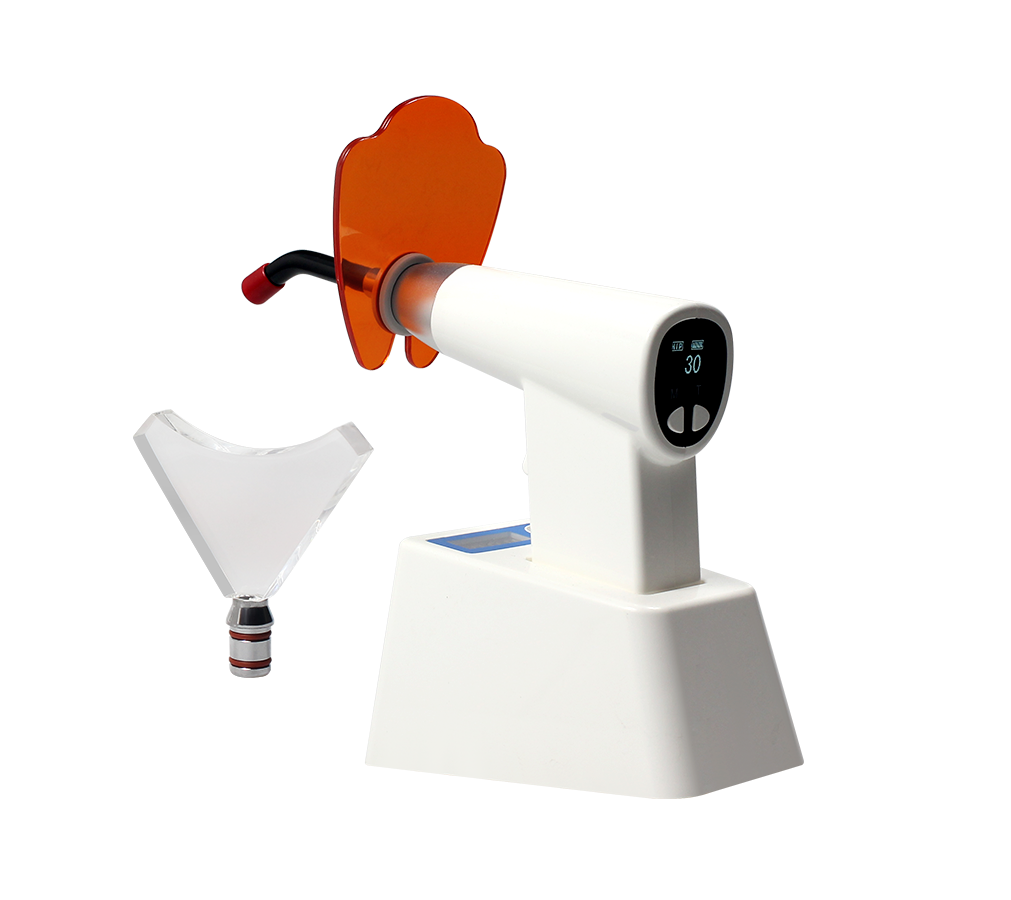
**IV. Advantages of Foshan Liangya curing light**
As a well-known brand in the field of oral medical equipment, Foshan Liangya's curing light not only have high-quality light guide designs but also have many advanced technological features. For example, its dual-color light design can meet the needs of blue light curing and purple light caries detection simultaneously; inductive charging technology makes the device more convenient and easy to use; automatic standby and automatic shutdown without operation effectively save energy and extend the service life of the equipment. These technological advantages make Foshan Liangya's curing light highly sought after in the market.

**V. Conclusion**
In summary, right-angle and angled light guides each have their own characteristics and applicable scenarios. When choosing, doctors should comprehensively consider the patient's specific situation, treatment needs, and their own operating habits. Foshan Liangya, as a leader in the field of oral medical equipment, produces curing light with not only high-quality light guide designs but also many advanced technological features, making significant contributions to the development of the oral medical field. It is believed that in future development, Foshan Liangya will continue to lead industry trends and bring more efficient and convenient treatment experiences to doctors and patients.
Light guide,Photocuring light guide,Photocuring machine manufacturer,Light guide manufacturer,Light shield manufacturer,Foshan Liangya,Foshan Liangya Dental Clinic,Curing light,Light cure
Other Information
Foshan Liangya – Oral Anesthesia Booster
Dec 09,2025
Foshan Liangya – Dental Plaster Mixer
Dec 05,2025
Address: Opposite to South China Medical Expo City, Airport Road, Nanhai District, Foshan City, Guangdong Province
Using small programs
Learn more
Copyright of Liangya Dental Equipment Co., Ltd. All Rights Reserved Powered by CEglobal privacy policy
SAF Coolest v1.3.1.2 设置面板 GAGSD-ZGYF-JQXZE-ZXD
无数据提示
No information for the time being